

Most roundups sort planters by material or by whatever finish is trending. Concrete this year, matte black the year before.
But, the correct way of sorting is through its shape. That is what decides whether a pot works or not, because shape sets depth, and depth sets what you can put in it.
That matters more in August than in April. You are not starting seed now. You are lifting a two-gallon root ball out of a nursery pot and asking a container to carry it through October. So the useful question about the best outdoor planters is not what they are made of. It is how deep they are and what shape they hold.
Why Shape Beats Material When You Buy in August
Here is the rule worth remembering: buy the form, then the finish.
A tall tapered cone and a wide shallow bowl take entirely different plants, and no amount of glaze quality changes that. Nursery stock in late summer arrives with roots already developed, so there is no growing-into-the-pot period left. The container has to fit on day one.
Depth also buys you time. A deep pot holds more soil volume, which means slower drying in September heat and more insulation when the first cold snap arrives. Shallow forms give up both, which is fine as long as you plant them accordingly.
Sort by shape first. Everything else follows.
Tall Planters for Height, Doorways, and Pool Decks
Tall forms do two jobs at once. They give roots real volume, and they add vertical presence where a bed is flat.
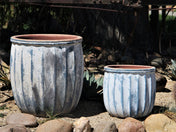
The XLG Cone Planter is the clearest example. It comes as a set of four in stepped sizes, so you can cluster them by a door or spread them across a yard and keep one look throughout. The full set weighs 238 pounds before any soil goes in, which is why it holds position on a windy pool deck.
The shape tapers from a wide mouth to a narrow base, so it reads taller than its footprint. That deep top section holds a small citrus or a ficus. Drop lavender or rosemary in the mediums. Finishes run Matte Black, Falling Aqua, Silver Rock, and Peacock Green, all hand-glazed earthenware rather than clay left bare.
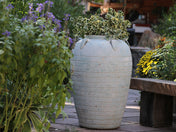
For a straighter silhouette, the Tall Barrel Planters flank a front door without the taper. Two matched Tall Planters either side of an entry is the oldest trick in residential design and it still works.
Our piece on why planter sets look professionally arranged covers the grouping logic.


Bowl Planters for Low, Wide Plantings
Bowls are not small versions of tall pots. They follow different rules.
A wide shallow vessel dries out faster because more surface area meets the air. It suits fibrous, shallow roots, not taproots. And it reads horizontally, which makes it right for a table, a low wall, or the front edge of a bed where a tall pot would block the view behind it.
The Succulent Bowl from Tuscan Sun is built for exactly that. Sempervivum, echeveria, and trailing sedum all want sharp drainage and shallow soil. The Veneto Planter Bowl gives you the same low profile with more room, useful when you want ornamental cabbage or a tight mound of mums instead of succulents.
Three graduated Bowl Planters beat one large one. You get to arrange them.


Greek Terracotta: Handled and Classic Forms
Handles on a planter are not decoration. They are the difference between a pot you can reposition in October and one you live with wherever it landed in June.
The Solina Planter with Handles comes in two heights. It is made on Crete and fired in kilns fueled with olive pits, which is where the warm earth tone comes from. The clay is left unglazed, so the walls stay porous and breathe. Water evaporates through the sides, which is genuinely useful if you tend to overwater.
The Koronios Planter covers the classic unhandled form. Both of these Greek Terracotta Planters develop a patina, and both rank among the large garden pots that look better in year five than in year one.
We went deeper on the Cretan tradition in our post on why terracotta never goes out of style.


Italian Terracotta and Why Clay Origin Changes How a Pot Survives
Nobody explains this well, so here it is plainly. Not all terracotta planters behave the same, and the difference comes down to the clay and the firing.
Italian terracotta from Impruneta in Tuscany uses Galestro clay, slow-fired at very high temperatures so the clay and its minerals fuse. That is what earns the frost ratings you see quoted well below zero. Greek terracotta from Crete gets its durability from thick walls and dense local clay instead.
Now the part almost everyone misses. The same porosity that lets good terracotta survive frost is what lets it survive heat. Pots that absorb water quickly are the ones that superheat, expand, and crack. Density and controlled porosity protect against both ends of the American calendar, not just winter.
That is the real argument for Italian Terracotta Planters and Luxury terracotta pots over a cheap clay pot from a garden center. You are buying the firing, not the color.
Browse the Italian Terra Cotta collection if you want the Large Outdoor Terracotta Planters end of the range.
Small Planters for Covered Patios and Sheltered Corners
Not every spot needs a 27-inch pot. A screened porch, a covered patio table, a shaded balcony corner: these want something you can actually see up close.
The Jewel Cache Pot Mix works as a cluster on a side table where the finish is the point. The Jewel Self-Watering Planter solves the problem that kills most small patio planters, which is that little pots dry out in a day when August hits 95. Both belong under cover, and both come inside once nights drop.


What to Actually Plant in Late August
Plant for October, not for the two weeks in front of you.
Ornamental cabbage and kale hold color through hard frost. Garden mums are the obvious pick and they are obvious because they work. Sedum 'Autumn Joy' comes into its own in September. Carex 'Everillo' keeps a chartreuse fountain shape into winter in zone 7 and warmer. In zone 8 and south, pansies planted now run right through to spring.
For deeper picks, see our guides to plants for large outdoor planters and pairing seasonal blooms with ceramic planters.
Start With the Shape
Deep and tall for trees and shrubs. Wide and shallow for succulents and low mounds. Handled for anything you will move.
Pick the form the planting needs, then choose the finish you like. That order is what separates Large Outdoor Planters that work from ones that just look good in a photo.
Shop All Outdoor PlantersFrequently Asked Questions (FAQs)
Is late summer a good time to buy outdoor planters?
Is late summer a good time to buy outdoor planters?
Yes, and arguably better than spring. You can see exactly where the yard falls short after everything has filled in, and fall stock goes in immediately rather than waiting on seedlings to establish.
What is the difference between Italian and Greek terracotta planters?
What is the difference between Italian and Greek terracotta planters?
Italian pieces from Impruneta use Galestro clay fired slowly at high heat until the minerals fuse. Greek terracotta from Crete relies on thick walls and dense local clay, traditionally fired in olive-pit kilns.
How deep does a planter need to be for nursery-grown perennials?
How deep does a planter need to be for nursery-grown perennials?
Match the pot depth to the nursery container plus about four inches. A one-gallon perennial wants roughly 12 inches of depth. Shrubs and small trees need 20 inches or more.
Can bowl planters stay outside through winter?
Can bowl planters stay outside through winter?
The pots can, if they are high-fired and frost-rated. The planting often cannot. Shallow soil freezes solid faster, so overwinter tender succulents indoors and leave hardy sedum in place.
Do glazed ceramic planters fade in strong summer sun?
Do glazed ceramic planters fade in strong summer sun?
No. Glaze is fired into the clay body rather than painted on top, so colors like Falling Aqua and Peacock Green hold through full sun. Rinse off dust and pollen a few times a season.