

Search for late summer garden advice and you get a chore list. Deadhead the annuals. Divide the iris. Spread mulch.
All useful. None of it explains why the yard still looks flat after you have done every item.
August is the one month when the planting has finished growing and stopped covering for you. Whatever the beds are going to hide, they are hiding right now. So a view that reads as empty in August will read as worse in November. The fix is not more plants. It is a small number of permanent objects, placed on purpose.
Why Late Summer Shows You Where Your Garden Falls Flat
In May everything is potential. By August the shrubs have reached their size and the perennials have filled in. This is the honest version of your yard.
Walk it now, before anything gets cut back. Stop wherever you actually stand or sit, and look at what you see from there. Not the whole garden. Just that view.
Most patio decor ideas stop at furniture and string lights. Start with the view instead, and you will usually find two or three of them are carried entirely by foliage that will be gone by Thanksgiving. That is the gap worth spending on, and why late summer beats spring as a buying window: you see the problem instead of imagining it. Our guide to moving summer containers into fall covers the planting side of that handoff.
The One-Per-View Rule: One Focal Point for Each Place You Stand
Here is the principle the rest of this runs on. A garden gets one dominant object per viewing position. Not two. Two objects in one view compete, and the eye settles on neither.
How to Count the Views in Your Yard
A view is a place a person stands, not a corner that looks bare. The back door. The head of the patio table. The window you look out of while making coffee.
Count them. A standard 40-foot backyard has three or four, not ten. That number is your budget.
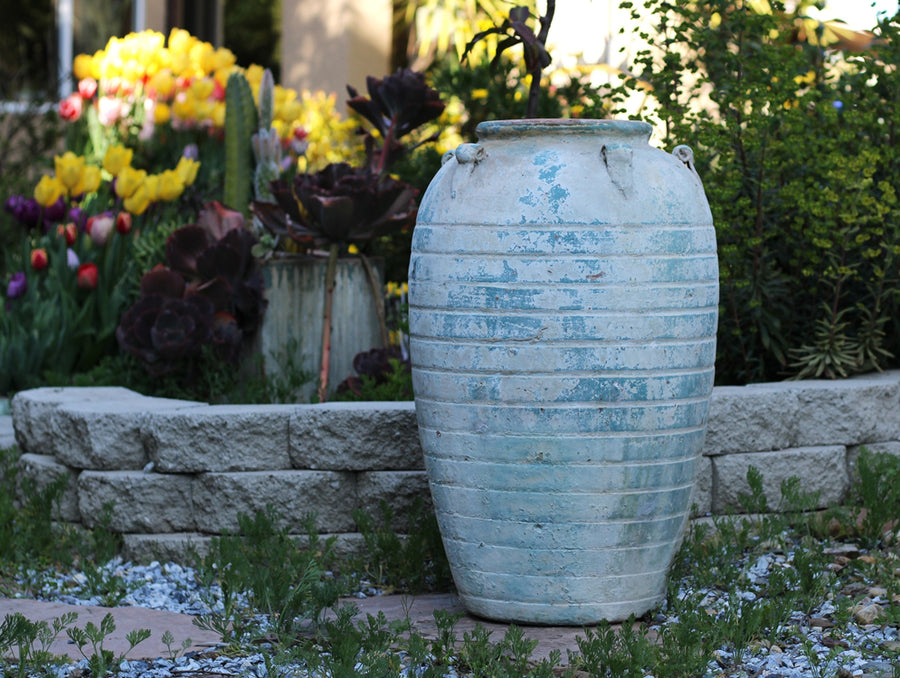
This is why buying nice pots one at a time produces clutter instead of design. Together they give you six objects fighting over four views. One good piece per view beats six adequate ones, which argues for a single anchor like the Ancient Amphora Large Planter rather than a scattering of smaller terracotta planters.

Pick One Main Object, Keep Everything Else Smaller
Secondary pieces are allowed. They just have to lose.
Keep any second object in the same view below two-thirds the height of the first. At that ratio the eye reads a hierarchy instead of a tie.

Corinthian Vase
The Corinthian Vase works in that supporting role, set back and off the main line of sight. The same stepped logic is what makes planter sets look professionally arranged rather than accidental.
Shop this pieceHow Big Your Planter Needs to Be for the Viewing Distance
The most common sizing mistake happens indoors. You judge a piece at arm's length on a screen, then set it 30 feet from the house where it shrinks to nothing.
Match the object to the distance. Inside 15 feet, high-twenties inches holds its own. Past 25 feet, you want to clear 30 inches of height before the piece registers as intentional, which is the real case for large outdoor terracotta planters over mid-size pots.

Single Water Jar
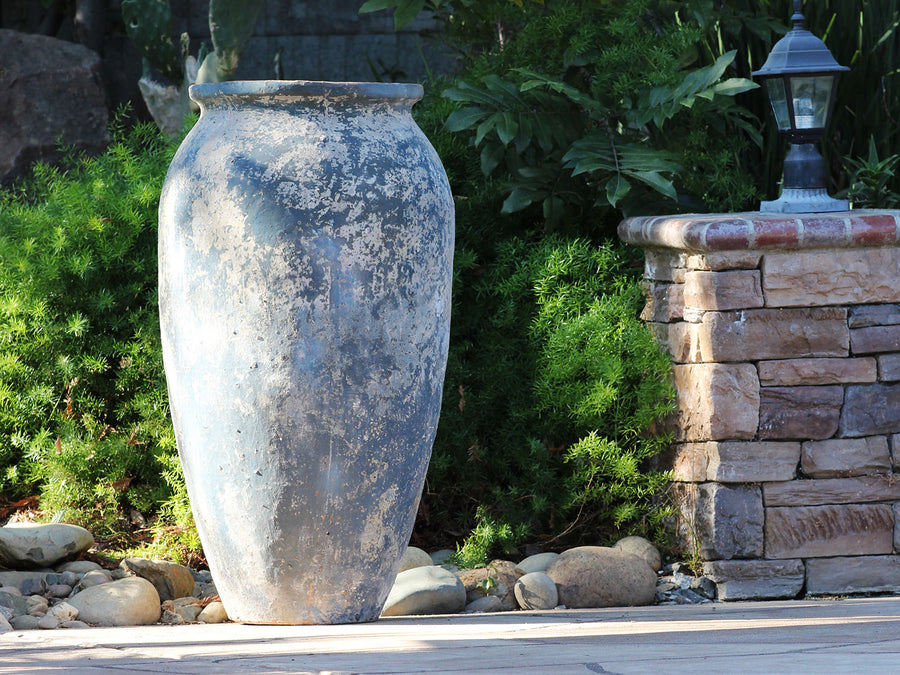
The Single Water Jar weighs 119 pounds. That weight is a feature. It does not shift on a slope or tip in a storm. It comes in Heirloom White, Graphite, and Atlantis Sky, which puts it in luxury terracotta planter territory.
Shop this pieceWhy Amphora and Jar Shapes Read Better Than Straight-Sided Pots
Shape matters more at distance than color does. A straight-sided cylinder reads as a container. A vessel with a shoulder and narrowed neck reads as an object, because the silhouette stays legible after surface detail drops away.
That profile is the basis of terracotta garden design and of the Mediterranean garden ideas that actually work in American yards. The Amphora carries grooved lines and leaf motifs down its sides, finished in Atlantis Sky or Verdigris. The Olive Jar does the same job with a broader belly.
Chateau and Tuscan planters are both earthen stoneware, wood-kiln fired at 2200 degrees Fahrenheit. No two come out alike, which is the point of handcrafted glazed pottery rather than a defect in it. We wrote about why terracotta and fired clay never go out of style, and our design guide covers how Mediterranean landscaping adapts to US climates.

Adding a Fountain: The Focal Point That Still Works After Dark
Every object above needs light and a line of sight. A fountain does not. It is the only focal point that works when your back is turned or the sun has gone down, so it earns its own view.
There is real evidence behind that. In a 2010 study in the International Journal of Environmental Research and Public Health, Alvarsson, Wiens, and Nilsson put 40 subjects through a stressful arithmetic task, then played them nature sound or traffic noise. Stress recovery ran faster during the nature recording, which was a fountain mixed with birdsong at 50 decibels.
The measured stimulus was moving water. Not a metaphor for calm, an actual fountain.
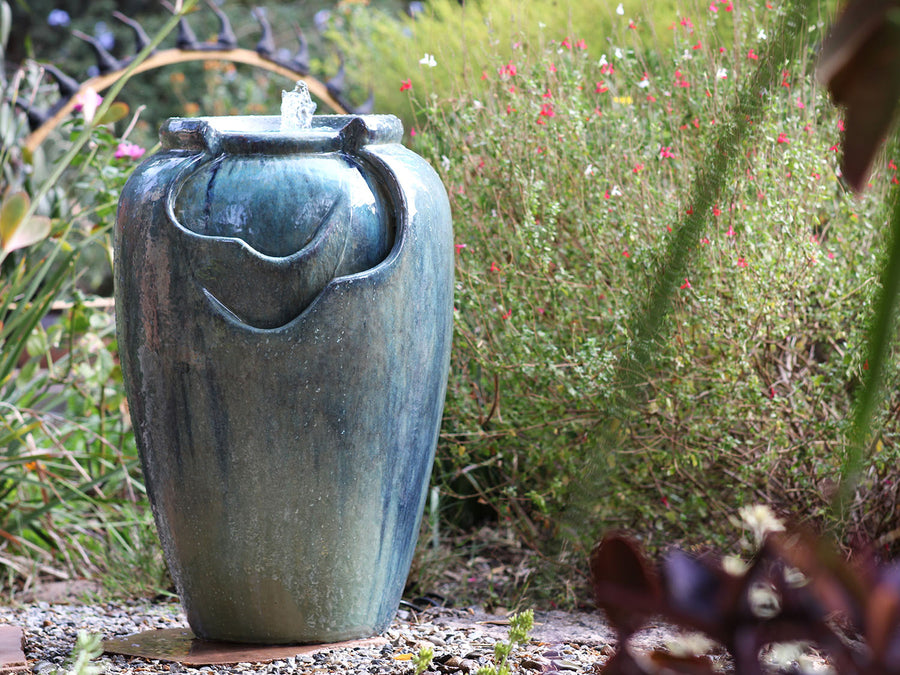
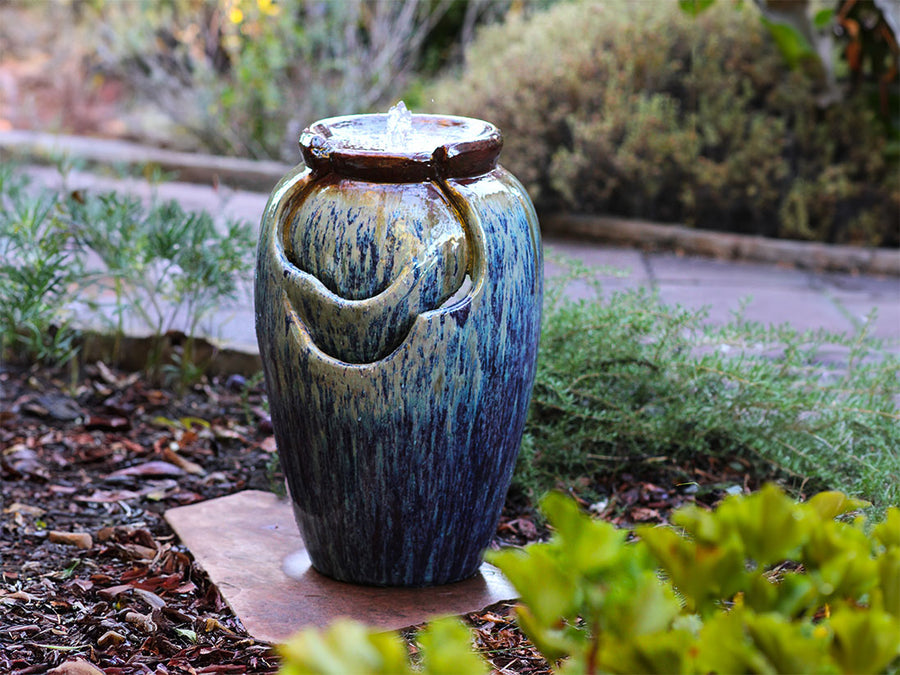
The Tea Garden Fountain in Deep Blue Sea and the Red Copper on Violet version are self-contained, so there is no plumbing run or basin to dig. Water fountains work hardest near seating, so set one within about 12 feet of where you sit. Past that the sound thins out. For more outdoor water fountain ideas, our ceramic water fountains guide goes deeper on outdoor water fountains than this piece can.
Where to Place Small Garden Accents
Small pieces earn a spot by being found, not displayed. Keep them below eye level and off the main axis. The edge of a bed. Beside a step where someone glances down.
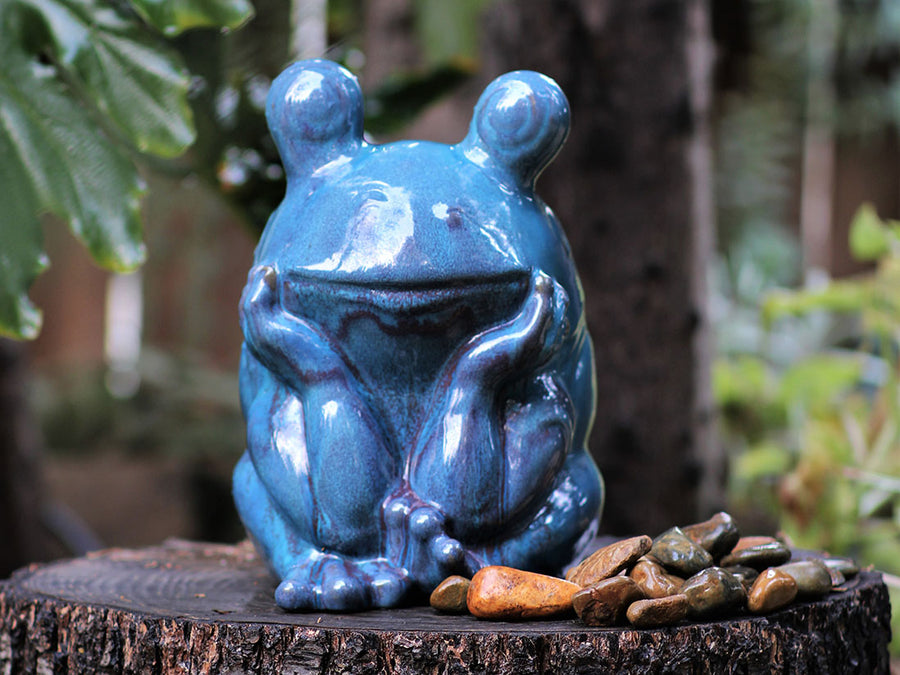
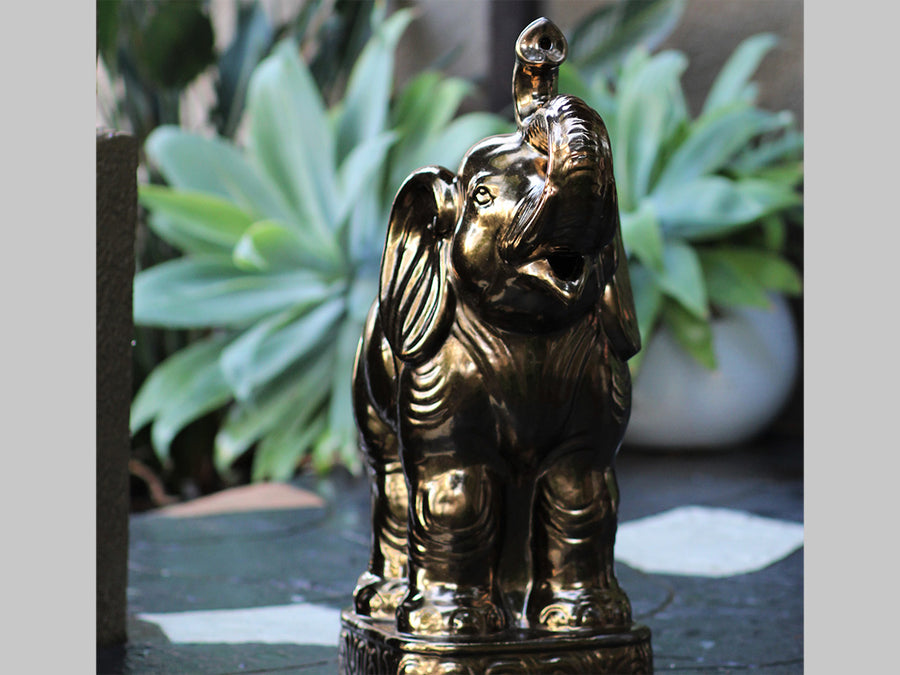
The Thinking Frog works at the foot of a planting, half in the foliage. The Elephant Accent reads well near a path edge where you pass it rather than face it.
Put either dead center in a view and it stops being a grace note. It becomes a second subject.
What to Plant So the Display Lasts Into Fall
A focal point is only as good as what is in it come October. Plant for structure, not peak bloom.
Panicum virgatum 'Northwind' gives you a stiff vertical that stands through frost. Sedum 'Autumn Joy' comes into its own in September. Heuchera 'Caramel' holds warm foliage color long after bloom. Carex 'Everillo' keeps a chartreuse fountain shape all winter in zones 7 and up. Ornamental cabbage is a good late swap once the annuals give out.
The Water Jar suits moisture-lovers specifically: irises, arums, even small trees given its depth. All of these pieces are frost-proof and stay out year round.
Start With Your Views
Count where you stand. One object for each. Size it to the distance.
That is the entire method, and it is the difference between garden focal points that look placed and a yard full of things that happened to get bought.
Shop the Chateau de Maisons Collection