

How much water the clay soaks up decides whether a terracotta pot survives winter outdoors. Pots that absorb under 5% of their own weight usually need very little help from you. Once absorption climbs past that level, water gets into the clay wall, turns to ice, and the pressure breaks the pot open. This depends on how the pot was made and fired in the kiln.
So, before protecting your terracotta pots from frost, first check what kind of pots you have. The rest of the work can be done in one afternoon.
Why terracotta pots crack in freezing weather
Terracotta frost protection starts with understanding the damage. Cold weather by itself does not harm fired clay. The problem is the water that the clay has already absorbed into its walls. When this water freezes, it expands by about 9% in volume. Inside a pot wall, that extra volume has nowhere to go, so it pushes outward against the clay around it.
One cold night is usually not enough to break a pot. Research on frost resistance in terracotta shows that the damage builds up over repeated freeze and thaw cycles. Each cycle puts stress on the tiny pores in the clay, and this stress adds up. By February, a pot that looked fine in November may have a thin crack running up from the base. Other pots flake instead of cracking.
This applies to every porous container. Our guide on why outdoor planters crack in winter covers ceramic, concrete and plastic too.
The 5% rule for frost-proof terracotta
The rule is simple. If a pot absorbs less than 5% of its own weight in water, it can usually survive outdoors. Above 5%, it holds enough water to crack itself.
The firing temperature decides which side of the line a pot falls on. Terracotta fired at around 900 to 1,000°C stays open and porous, and tests on this clay have measured water absorption near 14%. That is nearly three times the safe level, which is why cheap imported terracotta pots often fail in their first or second winter.
Clay fired above 2,100°F becomes much denser. Above 2,200°F it starts to vitrify, the pores close up, and water absorption drops below 5%. European ceramic standards test this with 25 freeze and thaw cycles.
| Clay type | Firing | Water absorption | Winter outdoors |
|---|---|---|---|
| Low-fired terracotta | 900 to 1,000°C | About 14% | Usually fails in one season |
| Frost-resistant | 2,100°F and above | 5 to 10% | Survives with protection |
| Vitrified, high-fired | 2,200°F and above | Under 5% | Survives untouched in most zones |
 Tetrahero Urn
Plantatorem's Greek terracotta is fired at 1,200°C, which is about 2,192°F, and it is rated from -4°F to 122°F. The Tetrahero Urn is a good example, with thick hand-thrown walls vitrified all the way through.
Our article on why terracotta never goes out of style explains how this clay has been made for thousands of years.
How to check the pots you already have
You do not need a laboratory to judge a pot. Four checks tell you most of what you need.
- Read the label. "Frost-resistant" means the pot handles light freezing but may still flake in a hard freeze. "Frost-proof" is the stronger claim and usually means high-fired clay. A stated firing temperature or minimum rating is the most useful information available.
- Pick the pot up. For the same size, dense and well-fired clay weighs more than open, low-fired clay.
- Look at the wall thickness. Thicker walls usually mean a better-made pot.
- Tap the side with your knuckle. Vitrified clay gives a ringing sound, and porous clay gives a dull sound.
 Koronios Planter
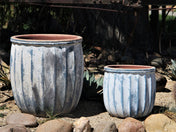
Hand-thrown ribbed pots like the Koronios Planter have visibly thick walls, which is one reason frost-proof terracotta pots of this kind do well outdoors.
Protecting heavy planters that stay outside
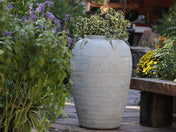
A large planter with soil and a shrub can easily weigh over a hundred pounds. The Pithari Urn weighs 75 pounds empty in its largest size and the Exara Planter weighs 50 pounds. Once planted and watered, they stay put until spring, so they need a winter routine instead of a storage plan.
- Raise the pot off the ground. Put it on pot feet, bricks or slate. This stops cold passing straight from the frozen ground into the pot, and lets water drain instead of collecting under the base.
- Remove the saucer. A saucer under an outdoor pot in winter holds water right against the base.
- Check that the drainage hole is clear. Push a stick through it. A blocked hole makes the pot hold water like a bucket.
- Reduce watering from late fall. Dormant plants need very little, and any extra water you give can freeze.
- Cover the soil with three to four inches of mulch. Shredded leaves, bark or straw all work. This keeps root temperature steady and slows freeze and thaw at the surface.
- Move the pot out of the wind if you can. A spot against a south-facing wall is better than open ground.
- Do not seal the pot. Sealing traps moisture inside the clay wall and works against everything else on this list.
If a heavy pot freezes to the ground, leave it until it thaws. Trying to lever it free is a common way to break the base.
When to start protecting your pots
Start after the first light frost and before the first hard freeze. If you start too early, wrapping or mulching in mild fall weather traps moisture against the clay for weeks. If you start too late, some damage may already be done.
In most of the US that means mid-October in Zones 3 and 4, late October to mid-November in Zones 5 and 6, November into early December in Zone 7, and December in Zone 8. Check your local first hard freeze date rather than the calendar. Our guide on caring for outdoor planters in changing seasons covers the other seasons.
Which pots should come indoors
 Solina Planter With Handles
Most high-fired outdoor terracotta pots are better left where they are. Bring in only the ones genuinely at risk: small pots, thin-walled pots, unlabeled pots, and any pot you would be upset to lose.
Pots with handles are easiest to move. The Solina Planter With Handles is the lightest piece in the Greek terracotta range and was made to be carried.
Store empty pots clean, dry and upside down in a garage or shed. Damp soil left inside keeps the clay wet all winter. Planted pots that come indoors need bright light and a saucer. Our notes on styling indoor planters this winter cover placement.
What to plant so the pot lasts too
 Panos Planter
Your choice of plant is part of winter planter care, because any plant that needs regular winter watering keeps the clay wet.
Choose plants rated for at least one zone colder than yours, because container roots sit closer to the air temperature than roots in the ground. 'Winter Gem' boxwood, dwarf Alberta spruce, 'Blue Rug' juniper and 'Hameln' fountain grass all handle hard cold with very little water. Helleborus 'Ivory Prince' flowers in late winter. For a Mediterranean planting, rosemary and lavender in a breathable pot like the Panos Planter need almost no water from December to March.
More combinations in our winter garden decor ideas.
Frequently Asked Questions (FAQs)
Can terracotta pots be left outside in freezing weather?
Can terracotta pots be left outside in freezing weather?
Yes, if they are high-fired and frost-proof. These can stay outside all winter in most US zones. Low-fired pots with no frost rating should come inside. Check the label, and raise any pot that stays outdoors onto feet.
Why do terracotta pots crack in winter?
Why do terracotta pots crack in winter?
Porous clay absorbs water into its walls. When this water freezes it expands by about 9% and pushes outward. Repeated freeze and thaw cycles build up the stress until the wall cracks or flakes.
Do terracotta pots need drainage holes in winter?
Do terracotta pots need drainage holes in winter?
Yes, and it matters more in winter than in summer. If drainage is blocked, water stays inside the pot and freezes. Clear the hole in fall and remove any saucer.
Should you bring terracotta planters indoors during winter?
Should you bring terracotta planters indoors during winter?
Only the ones at risk. Small, thin-walled or unrated pots are worth moving. Large frost-proof pots do better outside on feet, because moving a heavy planted pot can cause more damage than the cold.
How to protect large planters that cannot be moved?
How to protect large planters that cannot be moved?
Raise the planter on pot feet, remove the saucer, clear the drainage hole, reduce watering and cover the soil with mulch. Keep it out of the wind. Never try to free a planter that has frozen to the ground.