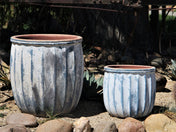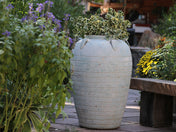


Your front porch gets looked at twice.
Once from the street, by neighbors driving past and anyone pulling into the driveway. Once from two feet away, by whoever is on the mat waiting for you to open the door.
Those two views ask for completely different things, and a porch display has to satisfy both. Most fall outdoor decor advice solves only the first one. These outdoor planters and the ideas around them are built for both.
The Two-Distance Rule for Porch Planters
From 40 or 50 feet out you register three things: height, mass, and silhouette. Surface detail is invisible at that range, and color reads only as light or dark.
From the doormat, all of that flips. Nobody is evaluating silhouette from two feet. They are looking at the rim, the surface, and whether the thing was made or stamped out.
So the rule is simple. Scale answers the street. Texture answers the door.
A galvanized washtub passes the first test and fails the second badly, which is why so much fall decor photographs better than it lives. Good decorative outdoor planters clear both.
Size the Planter for the View From the Curb
Height is the only thing that carries across a front lawn. A container that looks generous in a showroom shrinks against a two-story facade.
Go taller than feels necessary. A symmetrical pair flanking the front door is the arrangement that reads from furthest away, and it has been the standard entry treatment in American residential design for a century because it works.
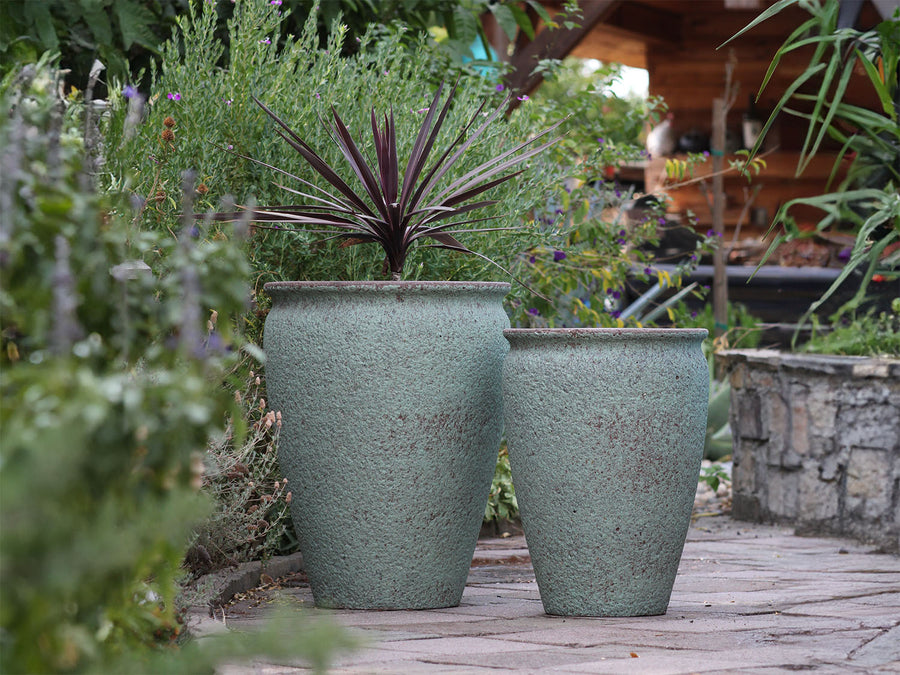
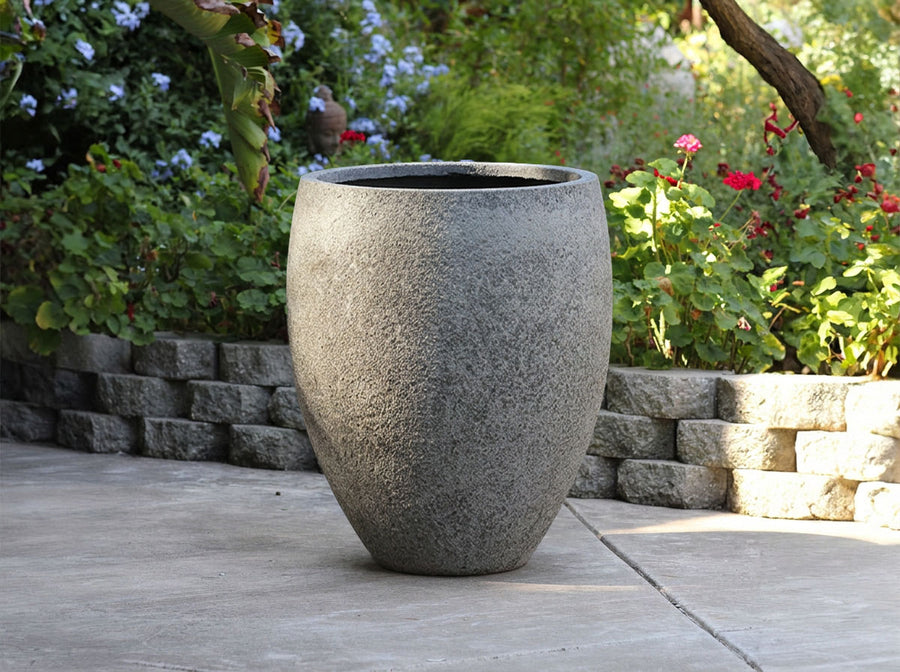
The Maximus Planter is built for this position. Its tall jar profile narrows toward the base and finishes in a thick rolled rim, so the silhouette stays legible from the sidewalk. It comes in Ivory Natural Stone, Green Limestone, and Grey Stone, and the weight keeps it put through a windy October. The rolled rim doubles as a grip when you are muscling it into position.
For a narrower footprint on a tight porch, the Alocasia Taper Planter gives you similar vertical presence without the spread. Both belong to the category of tall outdoor planters that actually earn the word.
Choose Texture for the View From the Doormat
Here is where material quality either shows or does not.
Someone waiting at your door spends thirty seconds looking at the nearest object, and on most porches that is a planter. At that range you can see mold seams, thin walls, and the plastic sheen that no amount of styling hides.
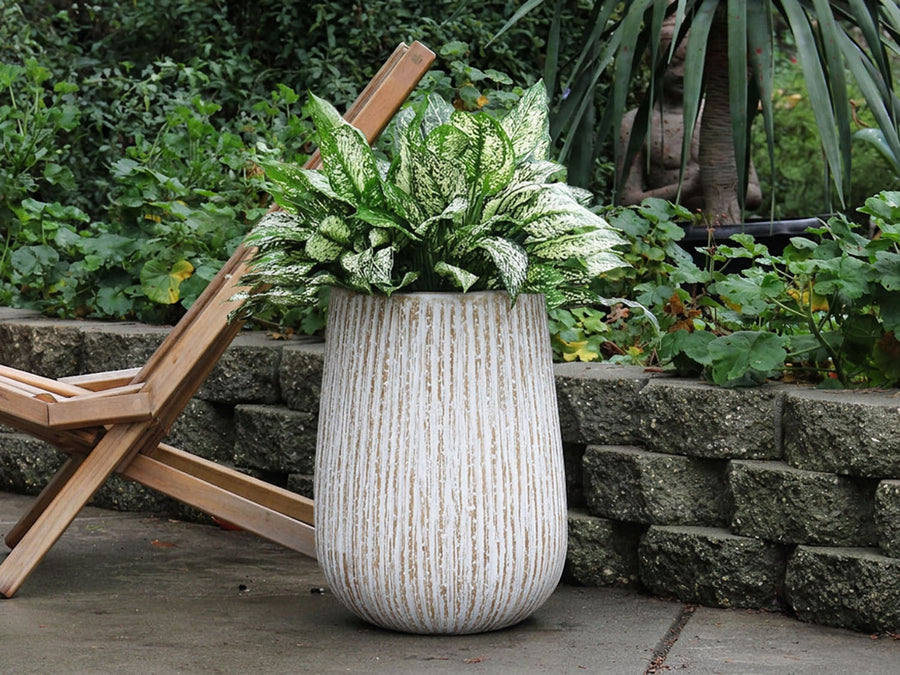
The Bark Texture Planter is made for close inspection. Its surface carries a ridged, bark-like relief that catches low autumn light and throws small shadows across itself, which is exactly the kind of detail that does nothing at 50 feet and everything at two. The Ridge Stone Planter does the same job with a banded stone relief.
The Maximus earns its place here too. Its pitted, weathered-rock exterior means no two pieces come out identical. The rough finish stops at the outside, so interior walls stay smooth and repotting is straightforward.
All of these are handmade high-fired ceramic planters, built as traditional earthenware with no plastic or fiber. That matters most in the one place people are standing still.
Match the Finish to Your House
A planter on a porch sits against your siding permanently. The two are in a relationship whether you planned it or not.
Work from what your house is already made of:
Red or orange brick
Go cool and neutral. Grey Stone or a limestone-toned finish keeps the brick from fighting the pot. Warm terracotta against warm brick turns into one undifferentiated mass.
White, grey, or blue-grey siding
A warm stone finish gives the entry something to anchor on. Ivory Natural Stone works on nearly any painted facade.
Natural stone or stucco
Match the texture and let color look after itself. A stone-finish planter against a stone facade reads as part of the architecture.
The Stonehaven Planter is the straightforward choice when you want the planter to look built in. This is the part of outdoor decor people skip, and it is the difference between a porch that looks designed and one that looks shopped.
Group a Stepped Set at the Base
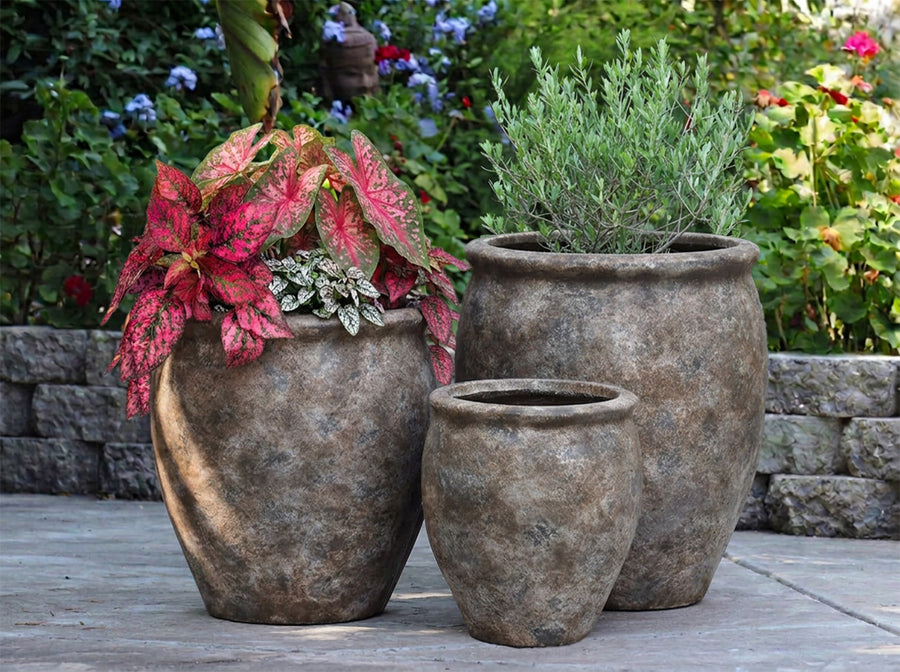
Below the flanking pair, work in clusters. Odd numbers, graduated heights, pulled back from the walking path.
The Titan Jar sells as a stepped set of three in a single finish, which removes the matching problem that makes most porch groupings look accumulated. Its squat, wide jar profile sits low enough to stay out of sightlines from the front windows. Patina Brown reads warm against grey siding. Green Lime Stone leans cooler and pairs well with brick.
Buying a set in one finish is the shortcut here. Three large planters in graduated sizes that already match beats hunting for coordinating pieces over three seasons, which is how people end up with eight pots and no arrangement. Our comparison of tall versus wide planter shapes covers which form suits which spot.
Fall Plants and Flowers for Porch Planters
Start with one condition most guides skip. A covered porch gets no rain at all. Containers under a roof overhang need hand watering straight through fall, and they dry faster than anything in open ground.
For the flanking pair, plant something that outlasts the season. A dwarf Alberta spruce or a boxwood holds shape through winter and gives you an entry that still works in January. Clumping bamboo or purple fountain grass suits the taller pots if you want movement, though fountain grass behaves as an annual outside zones 9 and 10.
For seasonal color at the base, the reliable fall flowers for planters are garden mums, ornamental cabbage and kale, and violas. Kale deepens in color as nights get cold. Heuchera 'Caramel' and Carex 'Everillo' both hold foliage well past frost. Tuck rosemary or creeping thyme at the rim of a larger pot so something spills over the edge. Those are the plants for outdoor planters that soften a hard ceramic edge.
For fall plants for planters that survive the winter in a container, see our guide to the best fall plants for large outdoor planters.
Leave Room to Walk
Porch geometry decides more than people expect. Four quick checks before you place anything.
Swing the front door fully open and mark where it stops. Nothing goes inside that arc.
Keep a clear path at least three feet wide from the top step to the door, wider if you carry groceries or use a stroller.
Set planters beside your steps, never on a tread. A pot on a step is a trip hazard in the dark, and October evenings turn dark by six in much of the country.
Finally, raise anything sitting on wood decking. Pot feet let water drain and air circulate, which protects the boards and helps the container through freeze-thaw. More on that in our guide to why outdoor planters crack in winter.
Buy for Both Views
Scale for the street. Texture for the door. Match the finish to your siding, group a stepped set at the base, and let the planting carry the season.
Get those right and your garden decor works in October, in February, and every month in between. That is the advantage ceramic outdoor planters hold over seasonal decor that goes into a box come November.
Frequently Asked Questions (FAQs)
What size planter is best for a front porch?
What size planter is best for a front porch?
Go taller than you think. A planter that looks right indoors disappears against a house facade. For a pair flanking a standard front door, choose something that reaches at least knee height on an adult standing beside it.
Should porch planters match each other?
Should porch planters match each other?
The flanking pair should match exactly, since symmetry is what makes an entry read as intentional. Groupings at the base work better in graduated sizes within one finish, which a set solves for you.
What are the best fall flowers for porch planters?
What are the best fall flowers for porch planters?
Garden mums, ornamental cabbage and kale, and violas are the dependable three. Kale intensifies in color as temperatures drop. Add Heuchera or Carex for foliage that holds long after flowering stops.
Do planters on a covered porch need watering?
Do planters on a covered porch need watering?
Yes, more than you expect. A roof overhang blocks all rainfall, so covered-porch containers rely entirely on hand watering. Check them twice a week through fall, and keep watering until the ground freezes.
Can ceramic planters stay on the porch through winter?
Can ceramic planters stay on the porch through winter?
High-fired ceramic earthenware is frost-proof and stays out year round. Set pots on feet so water drains and does not pool underneath, and make sure drainage stays clear before the first hard freeze.